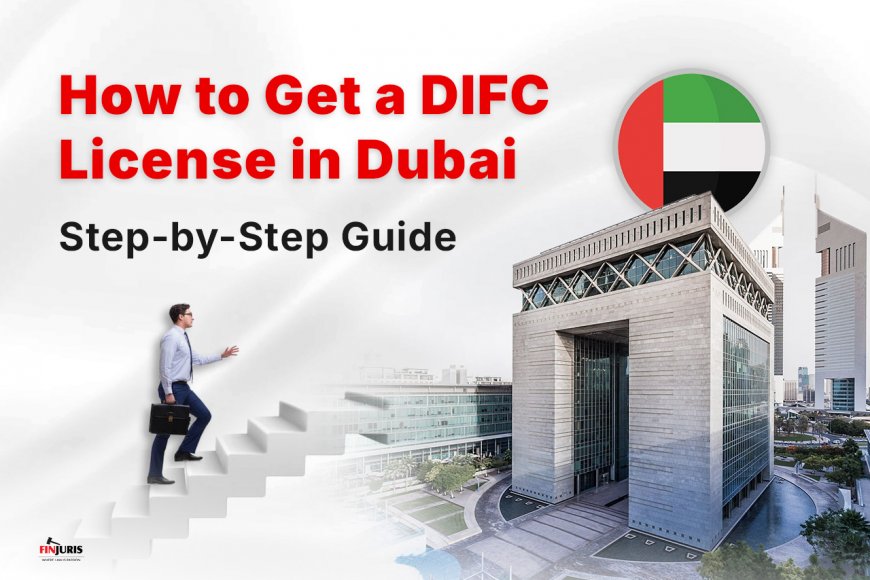
How to Get a DIFC License in Dubai: Step-by-Step Guide
Dubai International Financial Centre (DIFC) is among the best international financial centres globally, offering an independent legal and regulatory environment for conducting business in financial services and associated industries.
Dubai International Financial Centre (DIFC) is among the best international financial centres globally, offering an independent legal and regulatory environment for conducting business in financial services and associated industries. Thanks to its common law legal environment, independent courts, and regulatory standards recognized internationally, DIFC has become a favourite jurisdiction for banks, investment firms, fintechs, family offices, professional service firms, and multinational enterprises.
If you wish to incorporate your business in DIFC, it is necessary for you to be aware of the licensing procedure. Even though there is a well-defined procedure for applying for licensing, businesses need to meet certain conditions relating to incorporation, regulatory compliance, and operations.
This article discusses the DIFC license process, company registration process, and the important steps to set up a business in the centre.
Read More: What Is a DIFC License in Dubai? A Complete Guide for Investors
What Is a DIFC License?
A DIFC license refers to a permit that allows a firm to conduct its operations in the Dubai International Financial Centre.
Depending on the kind of business activity planned, there are different kinds of licenses.
Generally, firms that operate in DIFC are categorized into two broad types:
· The regulated firms, which are authorized and controlled by the Dubai Financial Services Authority (DFSA); and
· Non-regulated firms, which are licensed by the DIFC Registrar of Companies for purposes such as consultancy, holding firms, family firms, technology, professional firms, and other allowable business activities.
Firms need to first ascertain whether the DFSA authorization is necessary or not.
Step 1: Identification of Business Activities
The identification of the business activity is the first step of the registration in the DIFC.
Business activities may be, for example:
· Financial advisory
· Investment management
· Wealth management
· Fintech
· Family office services
· Holding company
· Professional services
· Technology services
· Innovations companies
Depending on the chosen activity, you will have specific licensing procedure and regulatory requirements.
Step 2: Selection of Legal Entity Structure
There are several legal entity types in the DIFC that depend on the business model.
Typical types of legal entities are:
· Private Company Limited by Shares (Ltd)
· Limited Liability Company (LLC)
· Branch of a foreign company
· Limited Liability Partnership (LLP)
· Prescribed Company
· Foundation
· Special Purpose Vehicle (SPV)
Step 3: Reserve a Company Name
It is necessary to reserve the company name that meets DIFC criteria.
Also, the name of your company shouldn't conflict with the registered companies in the DIFC and meet other criteria of naming.
Regulated expressions need a special permission.
Step 4: Prepare Application Documentation
Depending on the type of activity proposed, applicants are normally expected to prepare documents including but not limited to:
· Incorporation documents
· Business plan
· Shareholder details
· Ultimate Beneficial Owner (UBO) details
· Copies of passports
· Proof of address
· Board resolutions (if applicable)
· Financial details
· Organisational structure
DFSA regulated businesses applying for licences will be required to prepare much more detailed governance, compliance, risk management and regulatory documents.
Step 5: Submit the DIFC Licence Application
When documentation is completed, the application is sent to the respective authority.
For DFSA regulated businesses, the application process normally involves the involvement of the DFSA licensing process.
For non-regulated firms, the application process normally involves submitting the application to the DIFC Registrar of Companies.
The relevant authority considers the application and requests for further information or clarification before issuing an approval.
Step 6: Complete Business Operational Setup
After the application is approved, businesses undertake their operational setup prior to engaging in business.
This may include among other actions:
· Leasing office space (where applicable)
· Opening corporate bank accounts
· Completion of employment and immigration procedures
· Implementation of governance procedures
· Satisfying any licence conditions set forth by the regulator/ licensing authority
The firm can only commence operations after satisfying the licensing requirements.
Read More: DIFC Licensing Categories Explained – Get Category 4 for Crowdfunding
DIFC Company Registration Time Frame
The time frame for forming your company in DIFC would be dependent on certain criteria such as:
· If the firm is regulated or non-regulated.
· Level of complexity of its operations.
· The completeness of the application.
· The responsiveness of the applicant in case of additional requests from the authorities.
· DFSA authorization required or not.
Applications for non-regulated firms would take less time compared to the applications that require DFSA clearance as regulated firms are scrutinized in greater detail for governance, compliance, and operational structure.
It is advised that you ensure that you submit all supporting documentation in order to avoid any unnecessary delay.
DIFC Licence Costing
The cost associated with setting up your business in DIFC would depend on certain criteria such as:
· The kind of license
· Company registration cost
· Office lease cost
· Costs involved in employee visa
· Regulatory cost (if any)
· Professional advisory costs
· Renewal cost
For regulated firms, there could be extra DFSA application and supervisory cost depending upon the type of financial services offered by your firm.
Ongoing Compliance Requirements
Acquiring the DIFC licence is just the start.
Companies have to continue adhering to ongoing legal and regulatory obligations, which can comprise:
· Licence renewal every year.
· Company registration.
· Keeping statutory registers up to date.
· Beneficial ownership requirements.
· Compliance with accounting and auditing standards.
· Compliance with employment laws.
· Data privacy rules.
· Compliance with corporate governance.
· Regulatory reporting for regulated entities.
DFSA regulated firms are additionally required to adhere to the DFSA Rulebook, comprising ongoing prudential, conduct, anti-money laundering and counter-financing terrorism, and governance obligations when appropriate.
Compliance allows companies to maintain good standing and avoid legal troubles.
Common Errors Made While Incorporating into the DIFC
A lot of companies end up making avoidable errors during the incorporation process.
Some of the errors include:
Selection of an Incorrect Business Activity
This is because different activities come with different licensing processes.
Choosing a wrong business activity may result in the need for changes later on in the application process.
Choosing an Inappropriate Legal Structure
This is where the legal structure chosen does not suit the company's operations, ownership, and even future plans.
Not Understanding the Regulatory Process
There are businesses which will need authorization from the DFSA and they normally underestimate the level of governance required during the licensing process.
This makes their process more efficient when they do so.
Not Starting Office and Operation Planning
Some licenses need the business to show that they are operationally ready before conducting any operations.
Importance of Professional Legal Guidance
Even though the DIFC provides an effective incorporation process, choosing the right path for licensing involves detailed analysis.
Professional legal experts will be able to help the business in terms of:
· Choosing the right business activities.
· Picking the right legal structure.
· Drawing up documents for incorporation.
· DFSA licensing requirements (where relevant).
· Corporate governance documentation.
· Regulatory interaction.
· Compliance obligations.
Seeking legal guidance from the very beginning will help to avoid delays and compliance issues.
DIFC continues to be a major jurisdiction for financial services, fintech, professional services, and international business.
Whichever is intended to be set up - a regulated financial institution or an unregulated commercial company, the business needs to consider its licensing approach, corporate structuring, and compliance approach even before starting the process of applying for the license.
With the help of legal guidance and proper preparation, companies can go through the process of setting up their business in the DIFC more efficiently and at the same time put themselves in a position to succeed.
FAQs
1. What is a DIFC Licence?
This is the licence that permits the establishment of a business in Dubai International Financial Centre. Depending on the nature of the business, the licence may be issued by the DIFC Registrar of Companies or requires separate approval from the Dubai Financial Services Authority (DFSA).
2. How can I obtain a DIFC licence?
This typically includes identification of the nature of the business to be established, choosing the form of the entity, preparation of incorporation documentation, submission of the application, obtaining of the relevant approvals and operational preparations prior to conducting business.
3. Must all DIFC companies have approval from DFSA?
No. It is only those entities conducting regulated financial services that must have the approval of DFSA. Several consulting, holding, technology and professional service companies only require DIFC commercial licence.
4. Are foreign individuals allowed to set up a business in DIFC?
Yes. Foreign individuals are allowed to establish a business in DIFC.
5. How much time does it take for a company to register in DIFC?
The timeline depends on the type of business, whether DFSA approval is required, the completeness of the application, and the complexity of the proposed activities.
6. What legal structures are available in DIFC?
Common structures include Private Companies Limited by Shares (Ltd), Limited Liability Companies (LLCs), Branches of Foreign Companies, Limited Liability Partnerships (LLPs), Prescribed Companies, Foundations, and Special Purpose Vehicles (SPVs).
7. What documents are generally required for a DIFC licence application?
Applicants commonly provide incorporation documents, shareholder information, beneficial ownership details, business plans, organisational information, identification documents, and supporting corporate records. Regulated firms may also need to submit governance and compliance documentation.
8. What ongoing obligations apply after obtaining a DIFC licence?
Businesses may need to comply with annual licence renewals, statutory filings, accounting and audit requirements, corporate governance obligations, employment laws, data protection requirements, and, where applicable, DFSA regulatory reporting.
9. Can a DIFC company operate outside the DIFC?
The ability to conduct activities outside the DIFC depends on the nature of the business, the applicable licence, and any additional regulatory requirements that may apply in other jurisdictions.
10. Why should businesses engage legal advisors for DIFC company registration?
Legal advisors can assist with selecting the appropriate legal structure, identifying the correct licensing pathway, preparing incorporation documents, advising on DFSA requirements where applicable, and supporting businesses throughout the incorporation and ongoing compliance process.
What's Your Reaction?