How Much Does a Crypto Exchange License in Dubai Cost? Fees, Capital Requirements, and Other Expenses
The crypto exchange license Dubai cost includes regulatory application fees, annual supervision charges, minimum capital requirements, company incorporation expenses, and operational compliance costs. Under the Virtual Assets Regulatory Authority (VARA) framework, a crypto exchange must pay an application fee of AED 100,000 and an annual supervision fee of AED 200,000.
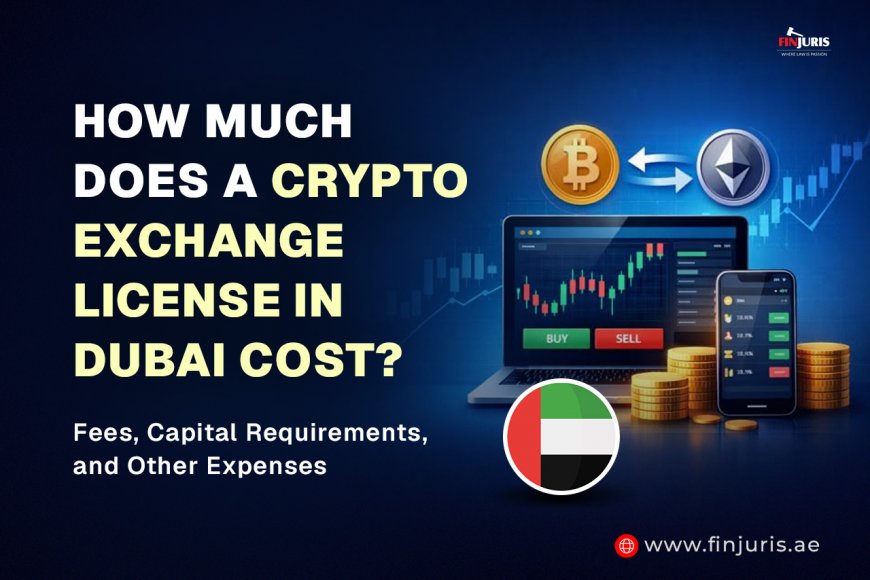
The crypto exchange license Dubai cost includes regulatory application fees, annual supervision charges, minimum capital requirements, company incorporation expenses, and operational compliance costs. Under the Virtual Assets Regulatory Authority (VARA) framework, a crypto exchange must pay an application fee of AED 100,000 and an annual supervision fee of AED 200,000.
Additionally, the minimum paid-up capital requirement starts at AED 800,000 for qualifying exchange models and AED 1.5 million for other exchange arrangements, subject to higher amounts based on annual overheads.
Understanding these expenses is essential for entrepreneurs and investors planning to establish a cryptocurrency exchange in Dubai. This guide explains the applicable VARA fees, capital requirements, licensing procedures, and additional expenses businesses should consider before commencing operations.
Read More: Crypto Exchange License UAE: A Legal Path To Run Your Crypto Exchange in the United Arab Emirates
Understanding Crypto Exchange Licensing in Dubai
The Virtual Assets Regulatory Authority (VARA) regulates virtual asset activities conducted in or from Dubai, excluding the Dubai International Financial Centre (DIFC).
Businesses intending to operate cryptocurrency exchanges must obtain the appropriate Virtual Asset Service Provider (VASP) licence before commencing regulated activities.
Under VARA's regulatory framework, Exchange Services include activities such as exchanging virtual assets for fiat currencies, exchanging one virtual asset for another, matching orders between buyers and sellers, and maintaining an order book to facilitate transactions.
The regulatory classification depends on the actual business model. For instance, a company operating a cryptocurrency trading platform with an order-matching engine may require Exchange Services authorisation, while a business facilitating transactions through external liquidity providers may fall under Broker-Dealer Services.
The distinction directly affects licensing obligations, operational requirements, and the overall cost of starting a crypto exchange in Dubai.
Read More: Difficult But Worth Obtaining Crypto Exchange License
What Are the VARA Crypto Exchange License Fees?
VARA prescribes specific application and annual supervision fees for regulated virtual asset activities.
According to Schedule 2 of the Virtual Assets and Related Activities Regulations 2023, the applicable Dubai crypto exchange license fees are:
|
Fee category |
Amount |
|
Exchange Services application fee |
AED 100,000 |
|
Annual supervision fee |
AED 200,000 |
|
Additional regulated activity |
50% of the lower applicable application fee |
Accordingly, a business applying for Exchange Services authorisation must budget AED 300,000 for the application fee and first year's supervision fee.
The annual supervision fee remains payable for continued regulatory oversight. VARA may also impose additional fees depending on the firm's risk profile, operational complexity, and supervisory requirements.
Read More: VARA vs. ADGM FSRA vs. DFSA: Which UAE Crypto Regulator Is Right for Your Business?
When Are VARA Licensing Fees Payable?
VARA follows a two-stage licensing process.
During the initial application stage, applicants typically pay 50% of the licence application fee to commence the regulatory review.
For Exchange Services, this generally represents AED 50,000.
Following Approval to Incorporate and progression towards full licensing, applicants pay the remaining application fee and the first year's supervision fee.
These payments are separate from company incorporation expenses, professional advisory fees, and the regulatory capital that businesses must maintain.
Read More: What Is the Difference Between a VARA License and a VASP License in Dubai?
VARA License Capital Requirements for Crypto Exchanges
The VARA license capital requirements represent one of the most significant financial considerations for prospective cryptocurrency exchanges.
Under Part VI of the VARA Company Rulebook, the applicable paid-up capital depends on the exchange's custody arrangements and fixed annual overheads.
Exchange Using an Approved Custody Arrangement
An exchange using a VARA-licensed custody provider, or another custody arrangement approved during licensing, must maintain the higher of:
- AED 800,000; or
- 15% of its fixed annual overheads.
Exchange Without a Qualifying Custody Arrangement
For other exchange arrangements, the required paid-up capital is the higher of:
- AED 1,500,000; or
- 25% of fixed annual overheads.
For example, an exchange with annual fixed overheads of AED 8 million and no qualifying custody arrangement would require AED 2 million in paid-up capital, since 25% of its overheads exceeds the AED 1.5 million minimum.
These amounts must be maintained in accordance with VARA's prescribed capital arrangements, including an eligible trust account, qualifying surety bond, or another arrangement specified by VARA.
Importantly, regulatory capital is not equivalent to a licensing fee. It represents a continuing financial requirement rather than an ordinary expense paid to the regulator.
Read More: How to Get a VARA License in Dubai: Complete Guide for Crypto Businesses in 2026
Additional Costs of Starting a Crypto Exchange in Dubai
Beyond regulatory fees and capital requirements, businesses must budget for several incorporation, infrastructure, and compliance expenses.
1. Company Incorporation and Office Expenses
A crypto exchange must establish an appropriate legal entity in Dubai.
Incorporation costs depend on whether the business is established in mainland Dubai or an eligible free zone.
Expenses may include trade licence fees, registration charges, office rental, employee visas, and administrative services.
Applicants should also consider the cost of maintaining an appropriate physical presence and operational infrastructure.
2. Legal and Regulatory Advisory Fees
Crypto exchange licensing involves extensive regulatory documentation and legal assessment.
Businesses may require assistance preparing their regulatory business plan, governance framework, AML/CFT policies, client agreements, risk management procedures, and outsourcing arrangements.
Legal advisors also assist with identifying the appropriate regulated activities, responding to regulatory queries, and addressing compliance gaps during the licensing process.
Professional fees vary according to the complexity of the business model and the scope of advisory services.
3. Technology and Cybersecurity Infrastructure
Cryptocurrency exchanges require secure and reliable technology infrastructure.
Common expenses include trading platform development, matching engine integration, wallet management systems, cybersecurity solutions, and transaction monitoring software.
Businesses may also incur costs for penetration testing, security audits, disaster recovery systems, and technology outsourcing arrangements.
The total expense depends on whether the exchange develops proprietary infrastructure or relies on third-party technology providers.
4. Compliance and Personnel Costs
VARA-regulated businesses must establish effective governance and compliance arrangements.
This may require appointing suitably qualified compliance personnel, a Money Laundering Reporting Officer (MLRO), risk management professionals, and technology specialists.
Additional expenses arise from employee training, AML screening tools, blockchain analytics, regulatory reporting, and independent compliance assessments.
These are recurring operational costs that must be incorporated into the company's financial projections.
5. Insurance, Custody, and Audit Expenses
Depending on the business model and applicable regulatory requirements, exchanges may need insurance covering relevant operational, professional, or digital asset risks.
Third-party custody arrangements can involve onboarding charges, transaction fees, and ongoing service costs.
Independent financial audits, cybersecurity assessments, and reserve verification may also create recurring expenses.
Under VARA's prudential requirements, VASPs must maintain sufficient net liquid assets and comply with applicable reserve asset obligations.
Read More: Difficult But Worth Obtaining Crypto Exchange License
Estimated Cost of Starting a Crypto Exchange in Dubai
There is no single fixed amount covering the complete cost of establishing a cryptocurrency exchange in Dubai.
However, the regulatory financial commitments can be illustrated using the following scenarios.
Illustrative minimum regulatory funding
Qualifying custody arrangement
AED 1.1M
Minimum capital plus first-year VARA fees
Other custody arrangements
AED 1.8M
Minimum capital plus first-year VARA fees
Assumes fixed annual overheads do not increase the capital requirement. These figures are not total startup expenses and exclude incorporation, personnel, technology, insurance, and other operating costs.
Businesses should distinguish between regulatory capital, one-time establishment expenses, and recurring operational costs.
For instance, although an exchange may satisfy the minimum capital requirement, additional funding will be necessary to develop its trading infrastructure, employ qualified personnel, and maintain regulatory compliance.
Therefore, the overall crypto license cost in UAE jurisdictions should be assessed through a detailed financial feasibility study rather than regulatory fees alone.
Read More: Crypto Exchange License in Dubai: Requirements and Application Process
How to Apply for a Crypto Exchange License in Dubai
VARA's licensing process generally involves two stages.
Stage 1: Approval to Incorporate
The applicant submits an Initial Disclosure Questionnaire through Dubai Economy and Tourism or the relevant free zone authority.
Supporting documentation generally includes the proposed business model, shareholder details, beneficial ownership information, and senior management particulars.
Following regulatory review and payment of the applicable initial fees, the applicant may receive Approval to Incorporate.
This approval permits the business to proceed with incorporation and operational preparations but does not authorise regulated exchange activities.
Stage 2: Full VASP Licence
The applicant subsequently submits comprehensive regulatory documentation demonstrating its operational readiness.
VARA may review governance arrangements, compliance policies, technology systems, custody arrangements, financial resources, and key personnel.
The process may involve regulatory interviews, additional information requests, and revisions to submitted documents.
A business may commence regulated Exchange Services only after obtaining the appropriate authorisation and satisfying applicable licensing conditions.
Read More: How Can a Foreign Company Get a Crypto License in Dubai?
Frequently Asked Questions
1. How much does a crypto exchange license cost in Dubai?
VARA charges AED 100,000 as the Exchange Services application fee and AED 200,000 as the annual supervision fee. Businesses must also maintain the applicable regulatory capital and fund incorporation, technology, compliance, and operational expenses.
2. What is the minimum capital required for a VARA exchange license?
The minimum starts at AED 800,000 for qualifying custody arrangements and AED 1.5 million for other arrangements. Higher amounts apply where the relevant percentage of fixed annual overheads exceeds these thresholds.
3. Is the VARA application fee refundable?
Applicants should treat the application fee as a non-refundable regulatory expense and verify the applicable payment conditions before submission. Payment does not guarantee that a licence will be granted.
4. Can a crypto exchange operate in Dubai without a VARA license?
A business conducting regulated Exchange Services in or from Dubai outside DIFC must obtain the appropriate VARA authorisation before commencing operations. DIFC operates under a separate regulatory framework supervised by DFSA.
5. Are there annual costs after obtaining a VARA license?
Yes. In addition to the AED 200,000 annual supervision fee for Exchange Services, businesses must budget for ongoing compliance, staffing, technology maintenance, audits, insurance, and other operational obligations.
What's Your Reaction?